Archive
How to know if you have a sense of physics – part1

By James H. Choi
http://Column.SabioAcademy.com
Source URL
Students who are good at physics have studied hard, but they also have an innate understanding of physical phenomena. Nowadays, studies have concluded that even newborns as young as a few months old understand gravity. For example, if a ball rolling on a desk leaves the desk and doesn’t fall to the floor, a newborn will watch it for a while longer. They notice that something is wrong.
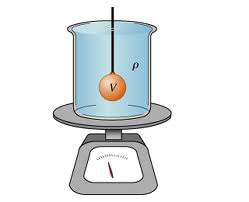
I think I’m one of those people who intuitively understands physical phenomena. One example I remember is a question posed by my teacher in first grade physics class. In the situation on the right, the question was, “What happens to the scale if you put the orange weight in the water or not?
It seemed illogical to me that there would be no difference between putting the weight in the water and not putting it in the water. It seemed like it had to make a difference because it was in the water. However, I also realized that if the weight touched the bottom of the beaker, the entire weight would show up on the scale, but if it floated in the middle, it would show up lighter. But I also realized that the lighter weight had to be something logical and mathematically calculable, so I raised my hand and said, “It goes up by the weight of the water in the ball’s volume.” The teacher was right. The teacher said I was right. I hadn’t learned about buoyancy until then. It was just a guess that I made while trying to find a number that was greater than zero, lighter than the weight itself, and that I could calculate using the materials I had. I think I became addicted to the exhilaration of making that guess. Maybe that anecdote was the first step that led me to major in physics.
I always learned physics this way. Whenever I learned a concept, I would subconsciously roll a “tongbap (gut feeling)” and if my guess was correct, I would say with a pleasant feeling, “Then that means…” If I was wrong, I would nod my head deeply in understanding, and if I was right, my eyes would widen in “wonder” and I would learn with even more interest, and my “tongbap (gut feeling)” would be re-tuned, and I would try to grasp the principle more precisely the next time. Physics formulas were not memorized, but were a tool to codify my intuition, just as you can guess a length with your eyes, but use a ruler to measure the exact number. Whenever I look at a formula, I have a habit of looking for the denominator to go to zero and the square root to be negative. It’s the mechanical equivalent of tearing apart a machine to see if it’s broken, but it’s a very useful habit in physics. (If you look at Einstein’s formula for relativity with this eye, you can see at a glance that you can’t go faster than the speed of light without anyone telling you, and that momentum explodes to infinity once you reach the speed of light.)
There are two types of students who struggle with physics: those who are weak in math and cannot translate their intuition into formulas and formulas into intuition. This is a classic case of “physics is fun, but my grades are low”, as is the case of someone who struggles in a subject they are good at because they are not good at English. Learning math will take care of itself, and most of the time, they discover this after the fact.
The other type is when you don’t have a physics intuition. They think that physics is a series of esoteric formulas and that studying physics is about learning how and where to substitute what into which formula. However, physics is a subject that cannot be avoided from the start if you are not good at it. Just like learning English, if you are not good at it, you need to learn it better and earlier and bring it up to a certain level in high school. It’s like teaching English at a young age, because it’s an inevitable subject if you want to be a leader in the modern economy.
But how can you tell if someone is the type of person who has an intuitive understanding of physics or not? How can I take the above physics problem and see if I can solve it intuitively? Here’s an opportunity to experiment. The video below is just a video of what you see without any special effects. If you watch this video and can’t figure out how it was done by the end, you don’t have an intuition for physics. Just as a child born with a weak body should learn to exercise from an early age to normalize his physical strength, a student who cannot figure out how to shoot this video should learn to do science from an early age in the form of playing with it.
The faster you can figure out how the video was shot, the stronger your intuition is, but I don’t know how much intuition you need to figure it out in a few seconds. I figured out how it was shot by watching the first person walking, so I guess it took me about 5 seconds.
If you have a child in elementary or middle school, this is a fun and free way to measure your child’s physical aptitude.

 Sabio Column