Archive
Say “Haro!” to All Strangers
One word from an innocent child can deliver a punch far stronger than a speech by a linguistics professor.

 By James H. Choi
http://column.SabioAcademy.com
Source Link
During my stay in Japan, I took a week off my exchange researcher’s duty to travel the country. I traveled as far south as Hiroshima and as far north as Sendai. Basically, I traveled all the way to the two end points of the bullet train Shinkansen network.
In my travel to the Kansai area — which includes Osaka and Kyoto — I’ve seen a lot of tourist attractions and ancient temples. But the one instance that stays in my mind most clearly is the one that I don’t even have a picture to remember by. In fact, I don’t even remember in which city it happened. All I remember is just one word from a child.

I happened to walk through a residential area, and I had to ask for directions. I approached a group of young mothers taking their children somewhere and asked in Japanese for directions. They eagerly listened, understood what I asked, and replied kindly. We exchanged a few more words of gratitude and denial, following the rather strict Japanese communication protocol. As I was carrying this conversation, I was feeling smug about my Japanese ability. I could carry a conversation with unsuspecting natives, convey my meaning, and get my responses without any confusion. Hey, perhaps, they didn’t even notice that I am a foreigner! Am I that good?!Then a little preschool-aged boy — who was listening to the whole conversation quietly— looked up at me. As our eyes met, he waved his small cute free hand — the other hand was holding mother’s — and I smiled back at him. He had singularly harmless eyes and a peaceful face, I remember. Then he articulated his mouth and said:
“Haro!” in English.
So much for me going native. Until then I knew I blew my cover when the Japanese people complemented for my linguistic ability. Usually, in the middle of conversations, they would suddenly inject “You speak Japanese so well” which meant “I was wondering why you sound so strange, but now that I know who you are, your Japanese is not that bad considering you are only a foreigner.”
But this peaceful looking kid shot me down to my proper place with just one word, and he didn’t package it as a complement. He is so cruel! What happened to the famous Japanese politeness?? And he had to do it precisely at the moment I felt I was feeling good about myself, which is rare.
I got the directions all right. (I told you I was communicating particularly well that moment.) But the whole surrounding looked different afterwards: It looked more distant and foreign as if I am suddenly in a far, far away land, such as Japan.
Misery does not love company, it requires one. I don’t want to go down alone this way.
I have advice for all innocent-looking preschooler in Japan, and all other non-English-speaking countries for that matter. You never know when you will run into a foreigner with groundlessly inflated ego parading around your city. Your one word packs a far bigger punch than an hour-long speech by a linguistics professor. Go ahead and deliver!

Frying My Brain
Once I “fried” my brain by doing a “simultaneous interpretation” work without any break. After doing it for a week, I was bed-ridden for the subsequent week to recover from the abuse.
By James H. Choi
http://column.SabioAcademy.com
Source Link
When you use your body beyond its capabilities, you injure its parts. This could be your tendon, a muscle, or bones. But can you injure your brain? Can you actually fry your brain? I have. And I’d like to tell you how I did it.
Once, I heard news through the grapevine that a company was looking for a Korean interpreter to translate from English to Korean. Out of curiosity, I took the job, which was a temporary, one-week assignment. So I took a week of vacation out of my regular job to work at this other company.
The job took place at a global management meeting of the company, where an executive from Korea was attending. Not confident in his English, he wanted to hire an interpreter to assist him. We sat at a big seminar classroom where lecturers from a corporate office were teaching global management of the company’s ways and how to conduct business, how to do accounting, and so on.
I sat next to the Korean gentleman and said, “Greetings, I am your interpreter. Which part of the meetings and speeches would you like me to translate?”

I was expecting him to say he would indicate to me which parts he would like translated, such as when difficult words were mentioned. Instead, he said,
“Why don’t you translate the whole thing?”
I was taken aback. But I’d come too far to back out. So I said, “Yes,” and started translating the whole thing.
It’s not as if I had some translation booth assigned to me. We sat in the last row together, and I whispered everything into his ears. It was not so quiet because, of course, he had to hear. I probably annoyed the daylight out of all those around us by constantly mumbling in Korean, but that was not my fault. This was my job. So I did it.
As the lecturers began explaining certain things, ranging from cultural sensitivities to accounting and so on, I was translating the content into Korean. These lectures didn’t wait for me a bit. I didn’t exist (to the lecturers), so they carried on. I had to squeeze in the translations between the lecturers’ breathing time, which was not much.
Some speakers spoke slowly, so I was OK. Some speakers spoke really fast. I recall the accounting lecture was a quite fast speaker, but there I found out the fast speakers tend to repeat. I didn’t translate the repetitions, but even so I was dropping lines, despite trying my hardest to translate everything.
I’m fairly well-versed in Korean and English, so I hardly ever have to look up words in dictionaries. Thus the vocabulary wasn’t difficult for me; however, the sentence structure was. In English, you can say, “The house that was on the mountain.” But in Korean, the latter part has to come first. When someone says “house,” I cannot begin the same way in Korean. I must wait to see what kind of house this was, all the while remembering that this was a house, not a dog.
Here’s a convoluted example of what I would translate: “The house that was on the mountain, which was owned by a gentleman from Poland, which was invaded by Germany during the second World War, which was the longest war …” If a sentence like this came along, the translation was doomed.
But nobody was this vicious; most people didn’t talk so convolutedly. But I still had to hold a lot of information in my head and recall it later on. Those familiar with RPN logic on HP calculators are familiar with this type of information-memory recall because you have dealt with entering information and then running an operation later. (In fact, I suspect RPM logic was based on Asian languages or another type of verb-at-the-end languages.) But this kind of waiting problem is not an issue when I translate from Korean to Japanese — because the word order is the same. In fact, translating between Korean and Japanese or Spanish and English, you don’t have to know even what the whole sentence is; you can simply translate word-for-word without holding any information. It is equivalent to driving around using GPS, without ever knowing where those places are on the map. However, between Korean and English, this just wasn’t the case. I had to hold the whole string of words, juggling them in my head, and bring them back out later.
Probably on my second or third day out of six, I found some strange thing happening. I was always under pressure to speak, delivering information in the shortest amount of time yet in a coherent way. But I began to notice I was speaking while the lecturer was still speaking; I was no longer waiting for breathing breaks but instead speaking as soon as I had enough information to deliver. This is called simultaneous translation. You can see people doing this in the back booths of the United Nation. I always admired these people, thinking they were born with special genes enabling them to talk and speak at the same time. I have trouble repeating a sentence while listening to it, never mind interpreting it. At least, that’s how I was. Yet in this setting, I found myself slipping into simultaneous translation. (I had enough brain cells left to notice that.) I got fascinated by this. I was now one of the simultaneous translators, the people I’d considered super heroes. I might be super.
I got better and better. The next day, I intentionally pushed. I intentionally spoke while the presenter was still talking, and I was succeeding. This was super. I felt good about myself and this completely new ability and happily did my work enthusiastically.
As soon as the translating week was over, I went back to my routine life. Or so I thought.
The day after I got home, I fell mysteriously sick. I got so sick I was bed ridden for one week. I used up one week of vacation to make extra money and the other lying in bed. That’s how I blew two weeks of vacation.
But this illness was peculiar. I didn’t cough. I didn’t have a fever. I just fell dead on a bed and couldn’t stand up. I didn’t know the cause. Later, I accidentally found out what happened to my body. These simultaneous interpreters work 30 minutes at most, and then they need a break. There’s a team of two translators who rotate to relieve each other because this type of interpretation is so taxing on the brain that even the professionals cannot do it more than 30 minutes without frying their brains. I’d been doing it for eight hours a day for three days. I unwittingly had been frying my own brain, and I had to pay for this.
I hope that didn’t do permanent damage (although my friends who know me might say this story explains a lot). The story doesn’t end there, though. I got invited back for the same executive from Korea at the same event the next year.
Did I take the job?
Yes, I did. Perhaps you have to have lived as a poor immigrant to understand how difficult it is to give up an opportunity to make a few thousand bucks. But it was not just the money. I was curious whether I’d be able to handle the mental taxation this time: if I could handle what it costs our brains, what the burden is. So this time I was determined to survive and planned accordingly. I was able to do the simultaneous translation from day one; the training had stuck from a year before although I never attempted it since. But this time, I was aware I was frying my brain. So this time, when there was no lectures, I didn’t talk. I rested my brain and thought as little as possible. During meal times, when I’d previously been translating all table conversations, this time I spoke as least often as possible. Also, after work, I would jog around the hotel garden area, and I then slept nine hours each day. So I did my best to protect my brain and health; I ate healthily too, mostly salads.
And after a week?
Remember, even the professionals spend only 30 minutes on this, but I was spending far more than that. I was spending hours on end, and for six days in a row this time. But my sheer arrogance made me believe that I should be able to handle the burden and survive it.
Did I survive?
Yes, I did. After the conference finished, I returned home, resuming my normal life without falling sick this time. So it is possible to work as a simultaneous interpreter without frying your brain (or maybe my brain strengthened; I don’t know what happened, but I was OK).
Would I do this job again, if someone lured me with another couple thousand bucks of income?
I don’t think so. Just thinking about those days stresses me. Even more than solving math-competition problems, the simultaneous translation was the most challenging task I did with my brain. I think the difference between this translation and math-problem solving is the time pressure I have. The speakers in front of me were not even aware of my presence while talking at their own paces, and it was my responsibility to put the adjectives and relative clauses in the right spots, holding the noun while waiting for the relative clauses to finish, translating that and bringing back the noun — all that in real time was simply too stressful.
Although I’ve shown I have what it takes to do that job, I have no desire to make that my career. It’s just too hard, and the responsibilities are too big. (I worry: What if I drop a single word “not” in a sentence “We are not going to attack you” while interpreting under time pressure between the United States and North Korea? I could trigger a war!) For all those reasons, I’d rather not do that job.
And because of all the stress I experienced first-hand, I don’t want to recommend this job to you. That said, when the responsibilities are not so high, and the pocket money is pretty good (a few thousand bucks in a few days is not so bad!), then I recommend you try it. Learn what it feels like to fry your brain. Just make sure to allocate a few sick days right after your work days.
Your Lunch Partner Will Change Your Life
Next time you’re standing with a tray in hand, don’t look for your friends. You meet them enough anyway. Look for your superior: the higher the better.
Your Lunch Partner Will Change Your Life
By James H. Choi
http://column.SabioAcademy.com
Source Link
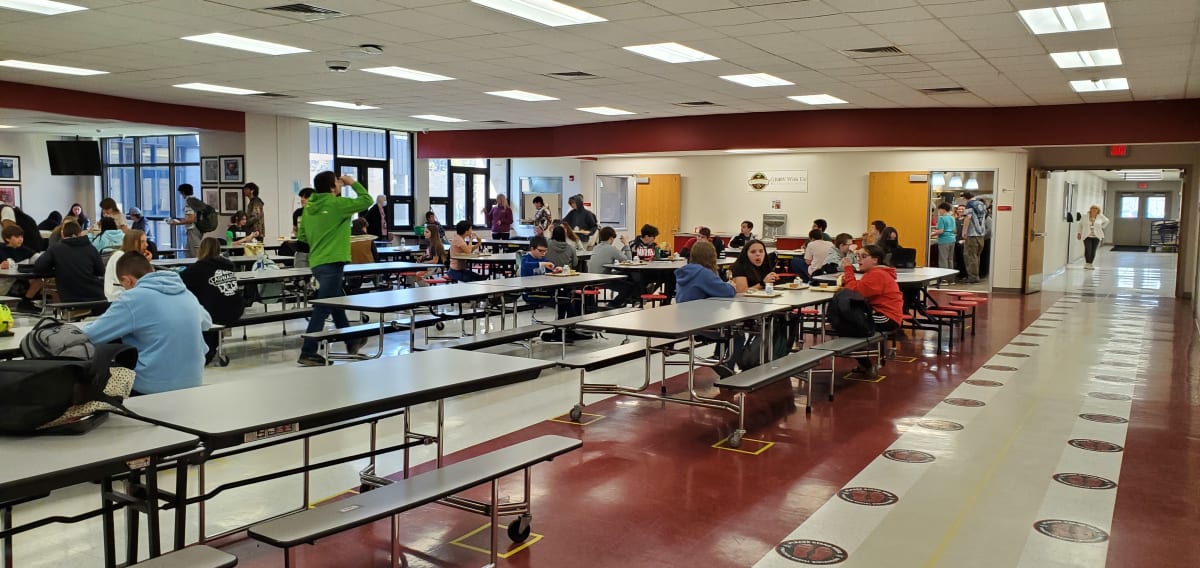 Let’s imagine a situation:
You pick your food from the cafeteria, pivot, and scan the horizon for a place to sit. You see a few people you know, and you see a few seats available across from those you don’t know.
Of all people to sit across from, who will you pick? Our natural instinct is to pick the people we know. They seem familiar, and we will feel safe. But if you want to advance your career, whether academic or professional, in high school or at an office, you have to choose the one who ranks highest. If you find a teacher sitting in the cafeteria, go and sit next to him. If you find a higher-ranking classman, go and sit by her. Same goes if you find your boss or boss’ boss, sit by that person. You might feel uncomfortable, but you’re not at school to feel comfortable. (If that were the case, sitting on your couch at home would feel much more comfortable!) You might feel awkward, you might not know what to talk about — that’s natural. But don’t worry. These people are professionals and will know how to guide you. Just by being with them you will gain insight from what they have to say; you don’t have to prepare any special questions or topics.
Once I had a chance to see a professional politician walk into a meeting and work the room. He was an ex-secretary of state of Illinois, and it was amazing how he could just walk into a room without knowing anyone and start shaking hands with strangers. I was in the same room, and my reaction was to stay quiet and try not to cause trouble for anyone, but his natural reaction was to get to know everybody and let everyone see who he was. He did it with such grace and aplomb that he didn’t seem forced. (If someone told me to do that, I would have been mortified; my insecurity would have shown in my attitude, and people would have been annoyed at my attitude.) But this politician did it with such grace, others had no choice but to be equally graceful and rejoice that he had chosen to shake their hands. I was equally mesmerized, instantly happy that I was able to meet him in person, and I shook his hand gladly. And that experience changed me. It still does not come naturally for me, but after having seen it in action, I know how to “work the room” if I must.
As a young person, you might not have that kind of caliber, but I think those who rise high display this, beginning perhaps during high school or college. If you don’t have it, you don’t have to doom yourself to the bottom rung the rest of your life, but you have to work at it, just as you’re working on your knowledge and experience. Work on your attitude, which could be even more important than your knowledge. Sharpen your social skills. Next time you’re standing with a tray in hand, don’t look for your friends. You meet them enough anyway. Look for your superior: the higher the better.
The Killer Inflation
Summary: I lived through 100% annual inflation in Brazil during the early 1980s. This is how it actually feels for a high school student.
By James H. Choi
http://column.SabioAcademy.com
Source Link

Among the experiences I had in Brazil living there from the late 1970s to the early 1980s, the inflation looms very large in my recollection. In fact, looking back now, I think it was closer to a trauma than an experience. The effect of having severe inflation, which reached 100 percent per year when I was living there, and then got even higher after I left, was that my memory of the prices of anything is a blur. I routinely bought many everyday things such as notebooks and bread; there were many things that I had coveted for a long time and then finally purchased (such as my electric guitar). But I do not have any recollection of the prices, not even the order of magnitude, I do not remember if it was a 1,000 cruzeiros or 10,000 cruzeiros or 100 cruzeiros. I just don’t even have a ballpark figure because during my stay, the price swept all up and probably went up tenfold or more (even that is not clear in my memory) during my time.
Having 100 percent annual inflation makes the whole conversation surreal. For example, suppose you see your friend’s guitar and want to buy the same one, and so you ask, “How much was that?” He says, “x Cruzeiros” And then the next question has to be, “When did you buy it?” Without that, that price is meaningless. If it was one year ago, you have to double the price. If it was two years ago, you have to quadruple it. If it was 6 months ago, you multiply by a square root of two. You get to learn the geometric sequence quickly, because otherwise there’s no way to learn even the ballpark price of anything.
In such situations and such an economy, cash is the worst thing you can hold in your hand. It’s like ice cream on a summer day: Literally, it’s melting away. So if you get any cash for any reason, the first thing you do is buy something you will eventually need before the prices go up. In fact, the price change had reached the point that taxi drivers could not update the meter frequently enough. They had a printout of a conversion chart dangling on the side, so when the meter is showing a certain amount, you had to look at the chart and pay some other inflation-adjusted price of the day.
At that time, Brazil didn’t have bar code scanners in the supermarket, so they had the price tags on every item. As the hyperinflation soared, it got to the point that they were upping the prices on the supermarket items daily. There was a crowd ahead, not behind, of that stock boy pricing the items, because one could buy the same item before the price is adjusted for the information.
Borrowing money or lending something to friends was tricky because if you borrowed ten cruzeiros, it’s not clear how much you would have to pay back a week later, never mind a month later. Just as businesses, some of us resorted to American dollar to measure the actual value although none of us were using that currency.
At that time, I wanted to buy an electric guitar, and I was saving up for it. And I remember that I just could not reach it. As soon as I could pile up just enough money to get the guitar, then the price moved again and again. It leads you to despair.
Postal service, by law, could not change its rate during the year. So it was stuck at the same price for some time. I recall the postal rate becoming so cheap that it felt like you could send packages for 30 cents or something like that (I don’t remember even a ball park figure). The postage went up by more than 100% when the new year’s day came around. I remember having dashed to send everything not because I wanted the season’s greetings to arrive on time, but because I had to send before the price more than doubled overnight.
My high school, Colégio Bandeirantes, used to have this payment brochure that you had to take and pay at the bank. But they had to give up on it. They could no longer predict what next year’s tuition was going to be. They issued new inflation-adjusted monthly tuition each month. And students had to attend without knowing what the total tuition was going to end up being.
Once you get used this kind of shifting ground, solid ground looks strange. At the time, my friend and I were looking at a Japanese guitar magazine. We were looking at one model name something like Yamaha 2000. We could not believe it when we found out that the model number was actually the price in Yen. In Brazil the price would not last two weeks, tops.
All of us, including myself, who lived through that period developed a habit of just “dumping” any cash in our hand before it loses value. In my case, this habit came back to bite me. When I came to the United States, as soon as I got a few hundred dollars, I bought a camera lens that I always wanted to get. So far so good. But a month later I found out the price went down. That came as such a shock to me. How can any price ever go down? I should have been happy, I guess, that I was no longer being buffeted by this hyperinflation left and right. I nonetheless felt so ripped off, I still feel that pain and the scar from those inflation years whenever I look at that lens I over paid. It took many years for Brazil to tame that inflation. I don’t know the details because it all happened after I left. It went through different currencies. At the time I was there, it was cruzeiro. Then came cruzados. Then the cruzeiro came back, and then now it’s the real. Each time the currency changed, they dropped a few zeros at the end to keep the numbers tractable. The picture above is the one cruzeiro note, the currency I used when I lived in Brazil. Ah, coins disappeared even while I was there because it’s metal value became higher than its nominal value, i.e., you get more money by melting it than spending it.
So when I hear in the news the inflation figures of a single-digit in the United States, I find the news very assuring. And when I hear in some other countries experiencing high inflation, I feel their pain. I know from experience that killer inflation hits the poor the hardest. Those who have properties can enjoy their property values inflating along with the inflation, but for those who have nothing — as it was the case for me back then — this was a horrible time to live because the wage never keeps up with the inflation, although the price of necessities (except for the postal service) always do.
At the time of this writing, Europe is going through its own currency crisis, and the solution is being complicated by Germany’s insistence on not printing money — because they are so afraid of the inflation. If the 100 percent inflation was enough to traumatize me like this, I cannot even imagine how the Germans — who have gone through some astronomical inflation, something along the lines of a million percent per year — would feel. I can understand that the Germans have something almost like an allergic, unconditional avoidance of just anything that would resemble anything like inflation.
It has been decades since left Brazil and the killer inflation. Brazil has changed a great deal since then as well. Although my friends used to joke that “Brazil is a country of the future and it will always be,” the joke was proven wrong: The future came. Brazil now is a formidable world power in every aspect. Killer inflation is a living, but distant, memory for people of my generation.
What If College Tuition Were Free? You have to be rich to afford it.
If college tuition were made free, ironically, only the rich will be able to attend. Here is why.
What If College Tuition Were Free?
You have to be rich to afford it.
By James H. Choi
http://column.SabioAcademy.com
Source Link
 What if college tuition were free? In Brazil, this daydream was the reality. Universidade de São Paulo (USP) — the best university in Brazil, and the best in Latin America according to US News Ranking — is practically free. Students pay no tuition, a few fees, and cheap, subsidized lunches (which where 10 cents while I was in high school). The logic is simple: Brazil offers the finest education to anyone capable of taking it, as proven through dint of their hard work, regardless of their financial background.
Of course, this free university tuition has unintended consequences. USP is, despite being free, filled with students of rich families. The school chooses its students based on scores from Vestibular, USP’s admissions testing system. Vestibular is the most intense entrance exam in the nation that is conducted in phases. A student’s university admission depends solely on these tests’ scores alone. No GPA, no extra-curricular activities are considered. In a way, it is a very logical and transparent process. To score high on these tests is to be admitted, but it is also to have prepared well. Those institutions that prepare students well for the Vestibular charge a lot. Therefore, USP admits students in droves from mostly just a few expensive high schools.
I know this well because I attended one of those high schools myself: the venerable Colegio Bandeirantes. At my school, students were so well prepared, some of us would take Vestibular at the end of the second year (as opposed to normal third year) to show off their precocious intelligence. (This was a pure showmanship. They could not enter the university because they did not have a high-school degree.) In the end, USP and other nearly free-tuition universities become packed with students from rich families who have paid extensively for preparation up to high-school years. This is the irony: To enjoy free tuition, you must be rich. “Matthew Effect” strikes again.
To make free university tuition democratically accessible, high-quality high schools would have to be open to students of all economic backgrounds. Once again, only some students would get admitted to these, and so this would spur competitive and expensive middle schools to shape students for the free high schools. Elementary schools and preschools would follow suit. And by the time students’ are competing to enter preschools, you have a new problem on your hands: The students’ fates begin to depend on their lives before they even enter elementary schools.
Friends of mine who are now professors at USP tell me the system is pretty much the same as it was when we attended; in fact, they say the favor toward the rich has worsened. Those who are in power and thus benefiting from this system have no motivation to change it. Thus, the working class people are paying for the tuition of higher class families. Who would have thought a free college education could become a model for social injustice?
Nor is this phenomenon unique to Brazil. According to The Economist: “The biggest single supplier of undergraduates to the University of Edinburgh was Eton.” Eton College is the British equivalent to the Philips Academy in the U.S. A prestigious high school famous for being attended by the children of the rich and influential, and producing influential figures.
Nowadays, the college tuition is an extremely controversial topic in many countries. At the time of this writing, a “Half-Price Tuition Movement” is afoot in Korea complete with candle-lit protests, and the Chilean students are demonstrating for “free high-quality universities for all.” North American universities are always mired on this controversy, and once-free British universities are now going through pains after they recently decided to charge university tuition.
It seems to me that every system has its own flaws and the best we can hope for is to select the system that is least bad. Beyond these vague words, I have no wisdom to offer. I would like to hear your actual experiences in the comment box below.
 Sabio Column